Yes - collagen gets a lot of hype from the beauty world for the way it promotes the health of the skin, hair, and nails, but the health benefits of collagen are more than skin deep. So even though we don’t buy into the anti-aging mindset, we still think collagen is an important part of a pro-aging beauty and health routine.
What is collagen?
Collagen is a family of proteins that our bodies naturally manufacture. It’s also the most common type of protein in the body. It’s secreted from a type of connective-tissue cell called fibroblast.
The purpose of collagen is to support the structure of our skin, organs, cartilage, tendons, ligaments, arteries, eyes, nails, and hair. In fact, a lot of experts call collagen the ‘body’s glue’ for the way it holds everything together.
What causes collagen depletion?
Over time, our bodies ease up on collagen production - it’s just a natural part of aging. This decline in production starts in our early 20s and accelerates over each decade.
For a woman going through the menopause, collagen production takes a dramatic nosedive (more on this below).
But it’s not just aging that decreases collagen. Other factors that contribute to collagen depletion include stress, lack of sleep, smoking, and exposure to pollution and UV rays.
Most of us will first recognise a drop in collagen by the changes in the look and feel of our skin. The skin starts to feel dry and thin, wrinkles and fine lines appear, and it becomes less smooth and firm.
Is there a way to replenish collagen?
Thankfully, yes - hydrolyzed collagen supplements have been shown to restore collagen in the body and improve the skin’s firmness and elasticity.
We feel it’s important to say that when it comes to beauty routines, we support ones that are pro-aging rather than anti-aging. We know that changes in the skin are a natural part of aging and not something anyone should be ashamed of. So it’s not that we’re trying to look decades younger.
But if you could take a supplement that literally makes you feel more comfortable in your own skin, why wouldn’t you?
Collagen supplementation isn’t just for looks; it’s crucial for wound healing and hydrated skin, and it supports dermal thickness and a more resilient skin barrier.
Is collagen supplementation just about the skin?
It’s true that the beauty benefits of collagen get a lot of hype. These include collagen’s ability to help retain firmness and elasticity of the skin, reduce visible signs of wrinkles, hydrate the skin, and support a healthy skin barrier. It can also contribute to thicker hair and stronger nails.
But studies show that long-term use of a collagen supplement has many benefits for overall health including reducing and preventing joint pain and protecting against degenerative diseases of the joints and bone, including osteoporosis.
Collagen also reinforces cartilage, supports muscle mass and strength, and supports gut health by strengthening the stomach’s lining.
Does collagen in skincare work just as well for the skin?
Probably not.
That’s because the collagen molecule is so large, it isn’t able to efficiently penetrate the skin, and it certainly has a hard time getting as deep as the dermis layer, which is where most of the skin’s collagen resides.
And of course, a skincare product only targets the skin, it won’t be able to enhance the health of your hair, nails, joints, bones, organs, and cartilage.
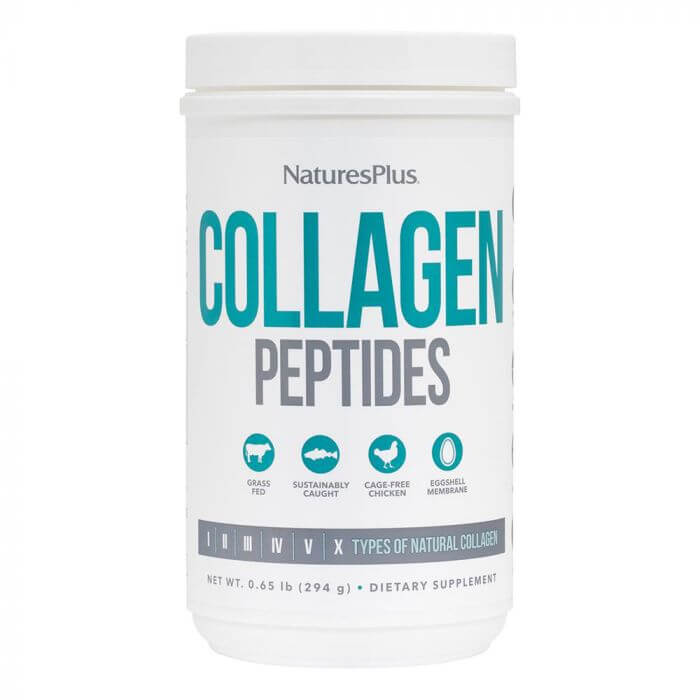
To receive the full benefits of collagen, experts recommend taking hydrolyzed collagen peptides, like NaturesPlus Collagen Peptides.
What makes hydrolyzed collagen peptides so special?
The body finds it difficult to absorb collagen, complex protein that it is, in its full molecular form.
(By the way, bone broth - while admittedly delicious and nourishing - isn’t considered a good source of usable collagen because of this. The collagen molecules in bone broth are too big for the body to break down and absorb.)
Hydrolyzed collagen is a simpler form of collagen, restructured into small protein chains called peptides.
These peptides are ‘pre-digested’, allowing them to pass through the body’s GI tract and into the bloodstream where, depending on the type of collagen they are, they can be absorbed by the skin, hair, nails, organs, joints, or bones.
Wait - there are different types of collagen? Which should I take?
Collagen can be categorised into at least 28 different types, all with their own unique sequence of amino acids, but the ones most important for health are types I, II, III, IV, V, and X.
Types I and III support overall health and are found throughout the body, including in the skin, hair, organs, gut, blood vessels, joints, and bones.
Type II is mainly found in cartilage where it supports strength and elasticity.
Most collagen supplements are either bovine (richest in types I and III), marine (contains types I and II), or chicken (contains type II).
Types IV, V, and X, which are most abundant in the membranes of eggshell, are not as commonly found in supplements as the other types of collagen are.
(By the way, if you’re vegetarian or vegan, we’ve got info just for you below.)
When choosing a hydrolyzed collagen supplement, it’s important to know which type it contains. For instance, if your aim is to improve skin health, you’re better off going with bovine collagen, which contains types I and III that both support skin, rather than chicken which contains type II that supports cartilage
And actually, that’s another thing we love about NaturesPlus Collagen Peptides - it contains all 6 types, so you get the full spectrum of collagen and its benefits.
How do I know if my collagen supplement is good quality?
These sources of collagen are inadvisable because of the levels of pesticides, heavy metals, antibiotics, and synthetic hormones that are given to the animals reared in factory farms.
To keep these contaminants out of your bloodstream, look for collagen supplements that are manufactured from humanely-raised sources.
We didn’t carry a collagen supplement until we found one that contains simple, clean, and sustainable ingredients. NaturesPlus Collagen Peptides is made from grass-fed beef, wild-caught cod, and cage-free chicken that all come from European sources.
How long before my collagen supplement takes effect?
While there’s no exact timeframe to guarantee when a collagen supplement will kick in, you can expect to wait at least several weeks and up to a few months to see noticeable differences in your skin, and several months to a year to notice an effect on joints, muscles, and bone density.
To experience results, it’s important that you take your collagen supplement consistently - yo-yo-ing on and off just won’t cut it. Think of your collagen supplement like a good hand cream that keeps your hands hydrated… as long as you use it every day… but the benefits quickly reverse when you stop using it.
How much collagen should I take each day?
Studies indicate that you can take anywhere from 2.5 - 15 grams of hydrolyzed collagen per day for it to be effective.
Up to 10 grams/day is recommended to benefit skin and joints while a dose of up to 15 grams is recommended for targeting bone and muscle.
What does collagen have to do with the menopause?
If you’re approaching or going through the menopause, you may have noticed some sudden changes in your skin, like your skin is much drier than you’re used to.
This comes down to the drastic dip in oestrogen during the menopause, and the role oestrogen plays in collagen production as well as many other aspects of how the skin looks and feels.
This decrease in oestrogen and collagen production affects not only your skin, but your tissues and bones as well, accounting for why postmenopausal women are at a higher risk of osteoporosis.
Taking a collagen supplement has been shown to improve bone mineral density in postmenopausal women and to stimulate the skin’s fibroblasts to produce and secrete collagen and elastin (which, along with collagen, supports the structure of the skin).
So reversing your body’s loss of collagen and lowering the risk of thin skin and weak bones can be as simple as taking a daily dose of hydrolyzed collagen peptides.
Got any recipe ideas for hydrolyzed collagen?
We sure do!
Since hydrolyzed collagen is a powder with a mild flavour, you can add it to a lot of different foods.
Hannah loves to stir a spoonful of NaturesPlus Collagen Peptides into her daily oat milk flat white, which makes it even creamier.
You can aslo stir it into black coffee or blend it into smoothies. It also works in soups, stews, and porridge. And if you’re feeling adventurous, a Google search will unearth all sorts of recipes for collagen cakes, pancakes, protein balls, and snack bars.
What if I’m vegan? Is a collagen supplement off the table for me?
While an effective animal-free collagen supplement is yet to come along (and you can bet we’ll pounce on it if one ever does), there are ways you can stimulate your body’s natural production of collagen if you’re vegetarian or vegan.
Pro-Collagen Vitamin C
Good ol’ vitamin C is a collagen cofactor for the way it stabilises the collagen that’s already in your body and stimulates the fibroblasts in your skin’s dermis layer to produce more collagen.
As an antioxidant, vitamin C also neutralises free radicals and supports the skin’s natural radiance and healthy cellular turnover.
There are many vitamin C options available, but Altrient C, in particular, has been shown in independent clinical trials to boost collagen production and improve the look and feel of the skin. Altrient C is a liposomal vitamin C that’s easily absorbed by the body. It delivers a higher dose to the bloodstream than non-liposomal forms of vitamin C.
In fact, vitamin C plays such a powerful role in collagen production, it’s a good idea to take it even if you’re not vegan and you’re on an animal-based collagen supplement.
Beyond vitamin C, echinacea shows a promising potential to protect the body’s collagen by inhibiting its breakdown by free radicals.
There’s also evidence to suggest that blackcurrants support skin health, especially in menopausal and postmenopausal women, through its oestrogen-like activities which increase the skin’s production of collagen, elastin, and hyaluronic acid.
Other plant-based ingredients which support collagen synthesis:
It’s an important protein that acts as scaffolding throughout the body, providing structure to the skin, nails, hair, organs, cartilage, muscles, and stomach lining
As we age, our body’s collagen level naturally drops, and our fibroblasts (the cells that secrete collagen and elastin) become less productive
The natural decrease in collagen causes the skin to lose firmness, elasticity, and moisture, and to increase the risk of joint pain, loss of muscle mass, and osteoporosis
Taking a daily supplement of hydrolyzed collagen peptides, such as NaturesPlus Collagen Peptides, can replenish the body’s collagen which supports the skin’s dermal thickness and decreases the risk of deterioration of the joints, muscles, and bones
If you have any questions about collagen or a pro-aging health routine, please get in touch with us ([email protected]). We love hearing from you and seeing how we can help you out.