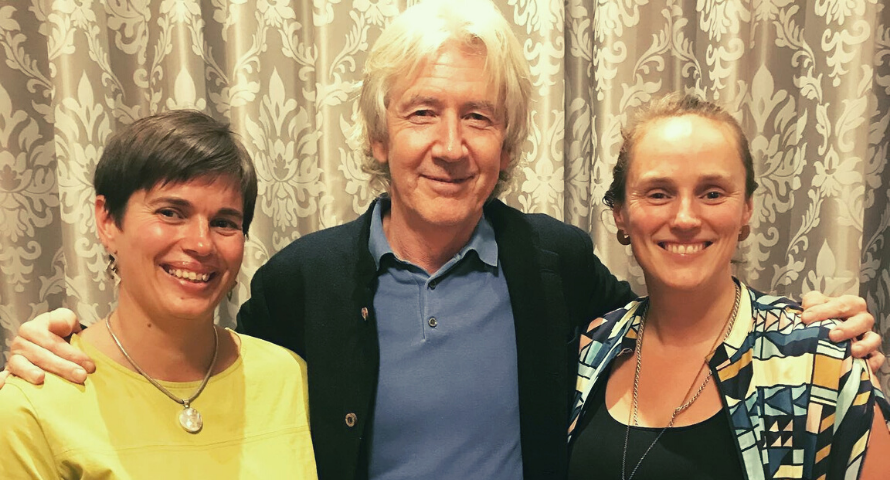
I hope you have had a healthy and happy summer. I love the summer, and this summer has been particularly lovely here in West Cork. The pandemic has made me really value where I live. As a family we have been outside a good deal - we got some fabulous good weather which we hadn’t expected but really enjoyed. However, heading into the Autumn and ‘back to school’ is concerning.
Back-to-school health
One thing that has really struck me since the start of the COVID is how many people have said they were much healthier compared to the previous Spring seasons. When you have young children in school, you learn to expect a certain number of coughs and colds, and maybe stomach upsets, but this spring in our family we had none of those. Many other families I know had the same experience. So going back to the school setting deserves some careful consideration in terms of building up our children’s immunity, so they can deal with the inevitable onslaught of bugs, let alone COVID.
Join us for our webinar with Patrick Holford
To help you to work out what's best for you and your family, we have enlisted the help of one of the most knowledgeable nutrition experts, Patrick Holford. We have invited Patrick to join us on a live Webinar on September 23rd at 7.30pm to discuss his recommendations around nutritional supplements and lifestyle tips for keeping the whole family in good health. Patrick has written a new book out on this topic - called Flu Fighters - and he really is a specialist in using targeted nutrients to maintain optimal health.
Our newsletter subscribers will be able to register for the webinar to watch it live and ask questions. We'll also send a playback link in our newsletter to anyone who can't attend live.
To make sure you have access to the webinar, sign up to our newsletter here and we'll send you details for registration as the event draws closer.
We also have a tentative plan to have Patrick visit Bantry for a one day Health workshop on October 25th, but current restrictions mean that it might not be possible. We will keep you updated on that through Facebook and our newsletter.
Patrick's article about vitamin C
To get us started, he has also sent us this article on the importance of remembering your daily Vitamin C - how much to take, why you are taking it and how much you should increase your dose by if you encounter a virus or infection.
There are two ways to not suffer from a virus. The first is to not get infected. That’s what masks and social distancing are about. The second is to have a strong immune response. That’s what vaccines and vitamins are about.
Vitamin C is one of the most powerful anti-viral agents without side-effects. There is no virus yet tested that isn’t either eliminated or substantially suppressed if exposed to high enough levels. The issue is how to get your blood levels high enough when infected.
Animals and vitamin C
Before exploring this there’s some background to vitamin C you need to know. Almost all animals make vitamin C (from sugars in plants) at remarkably high levels, and have the ability to make much more if exposed to a virus. Goats for example, make the equivalent of 15 grams (300 oranges worth) a day. Rats triple production of vitamin C if exposed to a virus. Why do they make so much? That’s why we’re not worried about our dogs, cats, sheep and cows. They’re all exposed but don’t succumb to infection.
Animals that don't make vitamin C include primates, most bats and guinea pigs. That’s how the guinea pig became the experimental animal of choice. These species share a period of jungle-based evolution eating a diet with very high vitamin C intake. Gorillas, for example, eat about 4 grams a day. The loss of ability to synthesise vitamin C is thought to have been an evolutionary advantage, leaving more available sugars for energy, at a time when these species had a high dietary intake.
Animals that make vitamin C are much less susceptible to the harmful effects of viruses. They may still carry some viruses but generally don't die from viral infections. Bats catch and carry but don't succumb because they do the equivalent of interval training when they fly, with their heart rate soaring to a thousand beats a minute. They are super-athletes with strong respiratory systems.
Intensive Care Units and vitamin C
Should we be doing what animals that make vitamin C do, eg massively increasing our intake under viral infection? Yes. Look at the sharp end. Intensive Care Units in the US and the UK who use intravenous vitamin C have a fraction of the mortality. The average mortality is over 40 per cent. In London, one ICU used 2 grams of intravenous vitamin C and dropped this to 33 per cent. In the US, two ICUs using 6 grams of vitamin C with steroids report 6 and 3.5 per cent mortality. They’ve also measured vitamin C levels in their patients and they were often undetectable, diagnosing scurvy. Vitamin C levels drop precipitously under viral attack. That’s why animals make more, and you need to take more.
Patrick's daily intake of vitamin C
I take 1 gram of vitamin C twice a day – the equivalent of 40 oranges - but up my intake to 1 gram an hour when under viral attack until symptoms disappear. Studies giving 6 or 8 grams in the first day of a cold show that half are symptom free within 24 hours. I also supplement zinc, which is in my vitamin C tablet, and make sure my vitamin D level is good. I purposely expose my skin every day to twenty minutes of sunlight to make vitamin D and supplement 1,000iu of vitamin D a day from October to March. These simple steps can make the world of difference whenever you get a viral infection.
Patrick (potentially) in Bantry
COVID restrictions permitting, we are also hoping to welcome Patrick to Bantry on October 25th to teach you how to stay healthy and disease-free in his Seven Secrets of 100% Health workshop on October 25th. Places are limited, and we will be announcing the workshop if it’s possible after the regulations are reviewed on September 13th. It is planned for the large conference room in the Maritime Hotel.
In the meantime, sign up to our newsletter so you'll be able to register to attend Patrick's webinar on September 23rd. We'll send out a registration link through the newsletter closer to the online event.